A video banking platform for remote consultations, customer identification, and service.
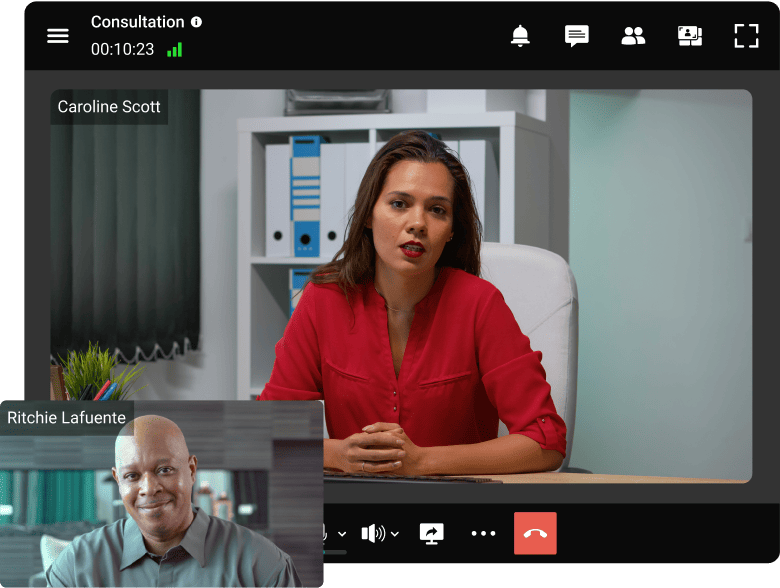
Offer remote support and provide advice to clients from anywhere in the world! Users can initiate contact with a bank support specialist in just one click, and automatic call allocation will greatly reduce the waiting time.
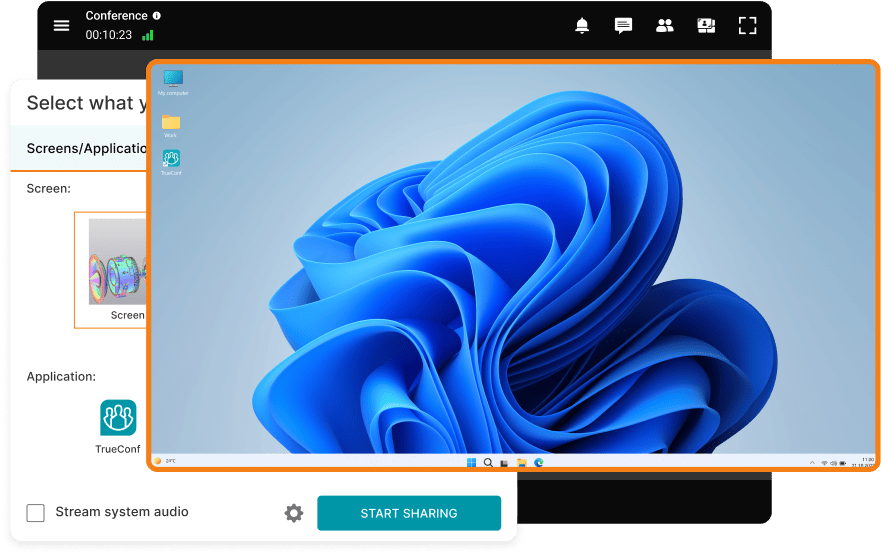
During a video call, you can easily share content with customers by showcasing images, presentations, videos, documents, and files.
Operation in a closed network without an Internet connection, encryption and full control over all communications.
TrueConf VideoSDK runs on Windows, Debian and Ubuntu platforms, and also supports ARM architecture.
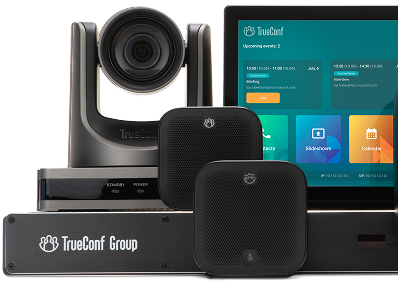
Combine the capabilities of endpoints and ATMs with TrueConf Kiosk, providing stable video communication with bank representatives and technical support.
Video banking is more than just a form of communication between a bank employee and a customer. It is a transformative solution based on video conferencing technology that is reshaping the landscape of customer service in the banking industry. Banks in the US, Canada, China, France, and many other countries are adopting video kiosks to serve customers remotely, significantly reducing the need for physical branches and long waiting lines.
Customers initiate a video call from a kiosk to connect with a customer service representative. Both parties can see and hear each other in real time. Using the kiosk, customers can perform various transactions, such as checking account balances, making deposits and withdrawals, and paying bills.
Video kiosks vary depending on the bank and the range of available features, but they typically include a video camera, a headset or microphone and speaker, a display screen for the representative’s video feed, and a video conferencing application.
Video banking offers numerous benefits for both customers and financial institutions. For customers, it provides a more convenient and personalized experience compared to traditional in-branch visits. They can complete transactions quickly without long queues and with direct assistance from a representative. For banks, video banking reduces operational costs by minimizing the need for physical space and on-site staff. It also enhances customer service by enabling more flexible and personalized interactions.
With the adoption of video banking, the mobility of bank managers has improved greatly, they no longer need to be in the office all the time to do their job. They can assist customers remotely, whether from home or on the go. In addition, rigid office hours can be replaced with more flexible schedules agreed individually with each employee.
Video banking is also a major advantage for bank owners who want to expand but are unsure whether a new branch will be successful. A video kiosk typically requires far less investment than a full-service branch, while still offering live support from a manager and the ability to complete many transactions digitally. With the right placement and service model, kiosks can help attract customers and strengthen your position in the local market. Moreover, integrating video kiosks into your customer service strategy can reduce costs while improving customer satisfaction and retention.
Another benefit of kiosk-based video banking is a clear improvement in customer experience. If kiosks are installed in convenient locations and enough staff are available online, customers don’t have to spend time traveling to a branch or waiting in long lines to complete a transaction or request an account statement. Customers value care, attention to detail, and a more personal approach.
The future of bank branches was called into question in 2020, when the coronavirus pandemic began spreading across the world. Those of us working in the banking industry found ourselves in an unprecedented situation. The shift toward digital platforms highlighted the importance of robust loan management systems and other financial technologies to support the evolving needs of the sector. The urgent need to eliminate mass in-person contact in order to prevent further spread of the virus created immediate demand for digital solutions such as video banking. New social distancing measures required many interactions, including customer service, to move online.
People turned to technology not only to speak with friends and family, but also to work, study, receive medical care, and manage their finances. For the first time, banks relied on video kiosks not primarily to reduce costs, but to maintain operational continuity and protect both employees and customers. “Banks have planned for years for disaster recovery if their technology failed, but have never planned for disaster recovery if their buildings closed,” says Chris Skinner, a leading influencer and advocate of digitalization in finance, in an article published by The Economist.
Remote interaction and online collaboration technologies adopted by financial institutions worldwide have equipped staff with tools to communicate internally and support customers in a safe and efficient way. For financial institutions, there are additional reasons to incorporate video conferencing into daily operations. Video-enabled customer service sessions allow banks to differentiate themselves, strengthen brand recognition, and provide a higher level of personalized service while building trust. Having experienced the advantages of video banking, organizations can now expand their digital ecosystems by integrating additional technologies and communication channels for further optimization. Branches can also combine traditional offices with video kiosks to better manage customer flow, especially in high-demand locations.
As financial institutions accelerate their digital transformation, clients continue to value the confidence, transparency, and human connection once exclusive to in-branch experiences. While digital tools excel at handling everyday transactions, like fund transfers or balance inquiries, they frequently prove inadequate when customers face nuanced financial decisions requiring expert insight, personalized advice, or detailed product education.
Video chat banking closes this experiential divide by facilitating live, visual conversations between clients and banking professionals, all within protected digital environments. This approach merges the agility of digital banking with the authenticity of face-to-face dialogue, allowing institutions to infuse warmth and humanity into remote interactions without compromising on security or operational speed. Clients can consult specialists, explore complex options, co-review documentation on screen, and reach well-informed conclusions, all from their preferred location.
For banks, video communication has evolved beyond a convenience feature into a core strategic asset. It elevates service quality, streamlines advisory workflows, and enables compliant, secure engagement even for highly regulated financial activities.
Automated channels efficiently support standardized tasks, bill payments, card controls, or transaction histories, empowering customers to act independently. Yet banking extends far beyond routine transactions. It encompasses substantial financial commitments, strict compliance frameworks, and the management of confidential personal or business information, contexts where clarity, accountability, and human judgment remain indispensable.
In these situations, purely automated or text-driven interfaces may breed confusion, delay critical decisions, or heighten the potential for miscommunication. Video banking overcomes these constraints by fusing digital efficiency with the confidence that comes from direct human engagement. Institutions can deliver timely, expert assistance precisely when needed, eliminating the necessity for physical branch visits.
Visual interaction with a qualified advisor substantially boosts client assurance, particularly during discussions about credit facilities, investment strategies, or sensitive account matters. Nonverbal cues, facial expressions, gestures, and vocal tone cultivate trust and authenticity in ways that chatbots, messaging apps, or audio-only calls simply cannot match.
For clients, seeing their advisor reinforces that a knowledgeable professional is personally invested in their needs. For banks, this dynamic nurtures deeper emotional bonds, enhances service transparency, and cultivates enduring relationships founded on reliability, not merely transactional ease.
Financial offerings like mortgages, asset management, business financing, and retirement planning demand careful explanation, comparative analysis, and documented client understanding. These services involve layered options, regulatory disclosures, and risk assessments that benefit from guided exploration.
Video sessions empower advisors to walk clients through each step visually, sharing screens to highlight critical contract terms, annotating documents in real time, and addressing concerns immediately. This collaborative method minimizes ambiguity, accelerates comprehension, and supports confident decision-making. Banks, in turn, can deliver premium advisory experiences remotely while upholding the professionalism expected in physical branches.
Migrating advisory sessions and complex support interactions to secure video channels significantly decreases branch congestion. This shift enables financial institutions to right-size their physical footprint, redistribute staff more strategically, and deploy specialists where their expertise delivers maximum impact.
At the same time, video banking dissolves traditional location-based constraints on accessing specialized financial guidance. Clients are no longer required to travel to specific branches for niche services, and institutions are freed from staffing limitations in particular regions. Centralized teams of subject-matter experts can serve geographically dispersed clients, minimizing role redundancy and lowering the average cost per interaction, all while preserving rigorous compliance standards and service excellence.
This model also aligns with evolving client expectations: customers increasingly want experiences that are digital-native, effortlessly convenient, and genuinely personal. They value self-service autonomy for routine needs, but expect immediate access to trusted advisors during pivotal financial moments. Video communication meets this dual demand, positioning banks as forward-thinking and client-centric by combining modern digital speed with authentic human engagement, a key differentiator in today’s competitive financial landscape.
Video banking enhances numerous client-facing and internal workflows across retail, business, and operational domains:
Personalized Financial Consultations: Advisors conduct immersive sessions on lending, investments, insurance, or retirement, tailoring guidance and building trust through interactive dialogue.
Digital Identity Verification (eKYC): Live video validates identity documents and confirms customer presence in real time, accelerating onboarding while satisfying KYC/AML mandates.
Guided Account Setup: New clients receive hands-on assistance completing applications and understanding product features, reducing errors and abandonment rates.
Business & Corporate Banking: Relationship managers maintain close ties with commercial clients through regular video touchpoints on treasury management, credit facilities, or growth strategy, without travel requirements.
Technical Support & Dispute Resolution: Visual troubleshooting, via screen sharing or camera guidance, resolves issues faster and reduces repeat contacts.
Internal Collaboration: Secure video connects branches, compliance units, headquarters, and remote staff, facilitating confidential coordination across distributed organizations.
Banks require purpose-built video solutions that meet stringent security, compliance, and integration standards, far exceeding the capabilities of generic conferencing tools. An enterprise-ready platform must address the following requirements:
• How can enterprise-grade security be embedded by design?
End-to-end encryption for data in transit and at rest forms the baseline. Equally vital are robust authentication (SSO, MFA), granular role-based permissions, session safeguards (unique links, waiting rooms, anti-spoofing), comprehensive audit trails, and centralized policy controls for recordings and data retention, all natively integrated rather than bolted on.
• Why is on-premises or private cloud deployment critical for banks?
To satisfy data sovereignty laws and internal risk policies, banks often mandate full infrastructure control. Private deployments keep media streams and metadata within corporate boundaries, enabling seamless integration with firewalls, DLP systems, SIEM tools, and internal governance frameworks, while eliminating reliance on third-party public clouds.
• How can consistent audio and video quality be guaranteed across branch networks?
Advisory sessions demand crisp audio and stable video, even across legacy branch networks or variable bandwidth conditions. Adaptive bitrate technology, superior noise suppression, and echo cancellation ensure professional-grade communication regardless of endpoint environment.
• How should a video platform integrate into existing banking ecosystems?
The solution should embed invisibly into mobile apps, online portals, and CRM platforms, enabling advisors to launch sessions with full client context visible. Integration with IAM systems and internal knowledge bases further accelerates resolution times and personalizes interactions.
• How can banks ensure reliable scalability during traffic surges?
Platforms must maintain performance during routine operations and traffic surges alike, supporting thousands of concurrent sessions with high availability, failover readiness, and proactive monitoring capabilities essential for financial continuity.
• Why is preventing vendor lock-in a strategic priority for financial institutions?
Banks require architectural flexibility to control deployment models, customize features, manage upgrade cycles independently, and avoid long-term dependency on external providers. This ensures the solution evolves alongside changing regulations, risk policies, and business needs.
When video becomes integral to client advisory and compliance-critical workflows, banks need more than a lightweight engagement widget. They require a resilient, self-hosted platform engineered for regulated environments, where data sovereignty, auditability, and IT governance are non-negotiable.
TrueConf Server delivers precisely this: a comprehensive enterprise video conferencing platform built for organizations that cannot entrust sensitive client interactions to public cloud infrastructures. Unlike narrow “digital engagement” tools designed solely for contact centers, TrueConf Server supports both external client consultations and internal secure collaboration on a single, unified architecture, simplifying management and strengthening governance.
Its deployment flexibility allows banks to operate entirely on-premises or within private clouds, retaining full command over session routing, media processing, and data residency. This model satisfies strict regulatory requirements while aligning with internal cybersecurity frameworks.
With security embedded at the architectural level, TrueConf Server enables centralized identity integration, policy enforcement, and access governance, critical for both customer-facing sessions and confidential internal discussions involving compliance or risk teams.
Engineered for enterprise scale, the platform reliably supports distributed branch networks, remote workforces, and fluctuating demand, ensuring consistent service quality organization-wide. Its open integration framework allows seamless embedding into existing banking applications, CRMs, and security stacks, transforming video from a standalone feature into a natural extension of daily workflows.
For financial institutions committed to security sovereignty, regulatory adherence, and long-term operational autonomy, TrueConf Server establishes a dependable foundation for next-generation video banking, delivering genuine face-to-face engagement in the digital realm without sacrificing control, compliance, or client confidence.